How Display Dummies Cut Theft, Insurance and Overnight Risk
Display dummies change what a break-in costs: real rings in the safe overnight, replicas under glass. The theft and insurance logic for jewellery stores.
How Display Dummies Cut Theft, Insurance and Overnight Risk
Quick answer: Display dummies cut theft and insurance risk by changing what is exposed, not by preventing break-ins. With a dummy program, the rings under glass — overnight, in the window, and on the road — are replaceable brass replicas, while real inventory stays in a rated safe. A break-in then costs glass and fixtures instead of insured stock, and the value an insurer sees on open display falls. Dummies complement safes, alarms and insurance; they do not replace any of them.
After closing time, the question every fine jewellery retailer faces is the same: what is actually in the case? The industry-standard answer is that real inventory goes into rated safes overnight — and increasingly, what stays under glass is a display dummy program. This guide lays out the security and insurance logic: what stays in the case overnight, what a break-in costs with and without dummies, how insurers see a display case, what dummies cannot do, and why the same logic compounds at trade shows and in travelling stock.
This article is general information about display practice, not insurance or security advice. Policies and risks differ by store; the operative steps are a conversation with your own insurer or broker and, where needed, a security professional.
In this guide:
- What stays in the case overnight?
- What does a break-in cost — with and without dummies?
- Daytime risk: grab-and-run and open handling
- How does insurance see a display case?
- What display dummies do not do
- What about trade shows and travelling stock?
- How a dummy program fits into a security routine
- Frequently asked questions
1. What Stays in the Case Overnight?
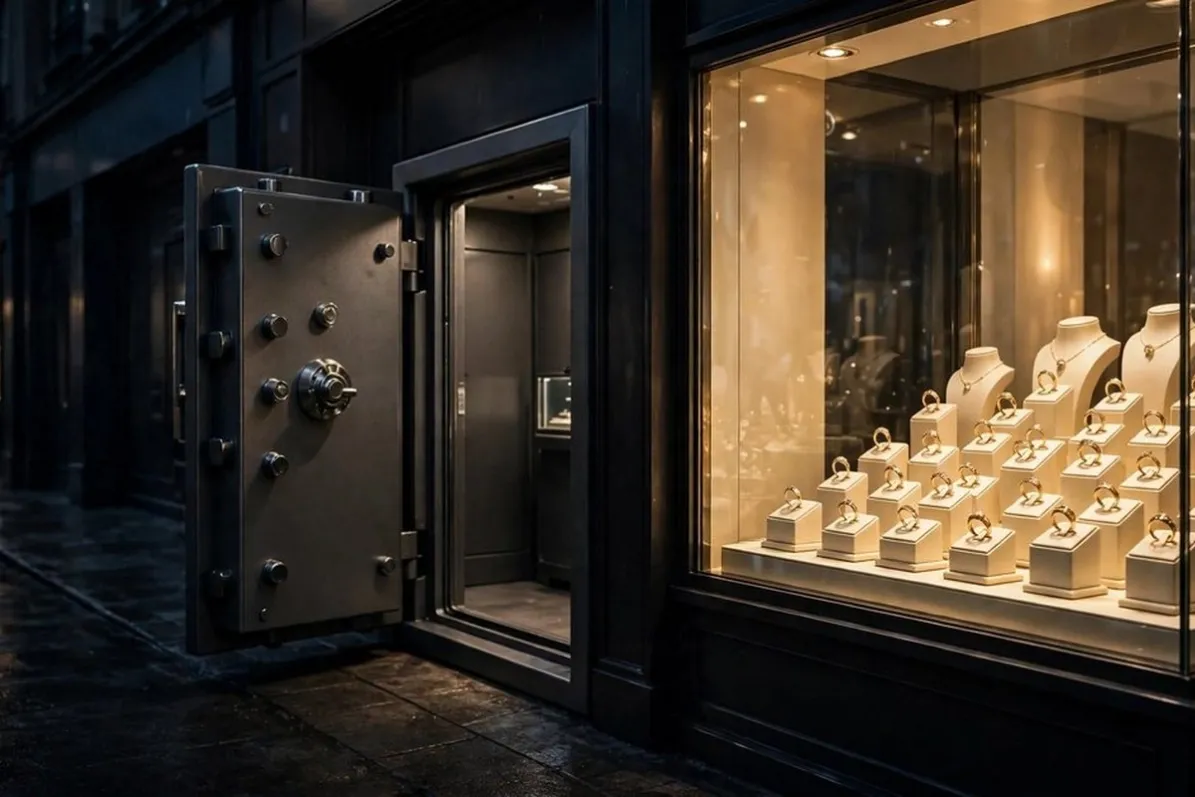
In a store running a display dummy program, what stays in the case overnight is the dummy set: brass replicas of the collection. The real pieces are in a rated safe — or are brought out by appointment during the day.
Smash-and-grab burglaries target display cases precisely because that is where visible inventory sits. After a widely reported Toronto jewellery store burglary, security experts repeated the standard industry guidance in the coverage that followed: real inventory belongs in rated anti-burglary safes overnight, not under glass.
Stores that follow the guidance with real display stock pay for it in routine:
- Nightly emptying and morning reset — every piece out of the case, into the safe, back out again, every trading day. It is labour, it is discipline, and it only has to fail once.
- Human error — the piece left in the case, the tray miscounted, the new staff member who did not know the routine. Overnight exposure is often an accident, not a decision.
- Safe capacity — a growing collection eventually outgrows the safe it was bought for. What does not fit stays out, or the store rations what it displays.
- The window problem — street-facing windows are the most exposed display of all, and the hardest to empty and re-dress convincingly every day.
Stores that display dummies simply lock the door. The case stays dressed, the window keeps selling after hours, and the safe holds the value.
2. What Does a Break-In Cost — With and Without Dummies?
A dummy in the window does not prevent a break-in. It changes what the break-in costs. The math is asymmetric:
| Case displays real pieces | Case displays dummies | |
|---|---|---|
| Stolen | Insured high-value inventory | Replaceable replicas |
| Claim | Loss claim, investigation, premium impact | Glass and fixtures |
| Downtime | Stock recovery, re-filing, re-manufacture or re-ordering of sold-out designs | Restock the set from the standing dummy program |
| Customer impact | Ordered and promised pieces may be among the losses | No customer piece is in the case |
| Emotional toll on owners and staff | High | Low |
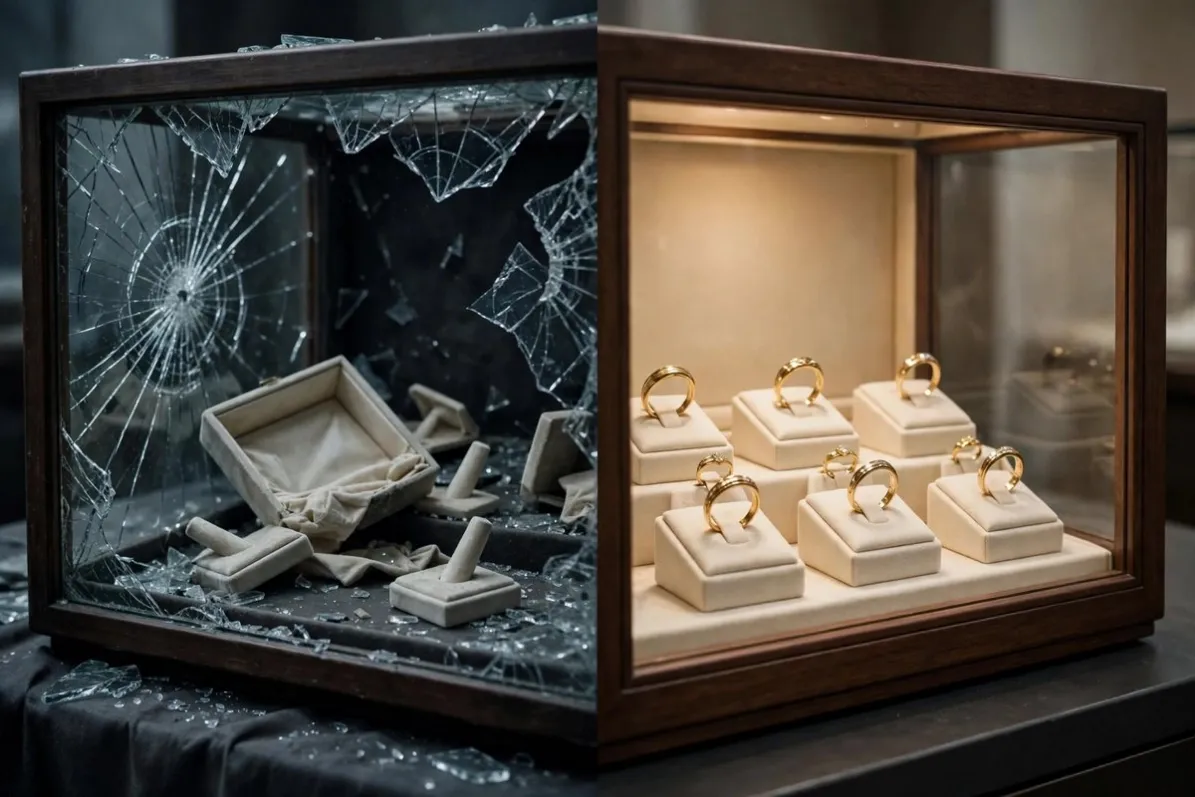
The last two rows are the ones spreadsheets miss. A store that loses real stock loses selling days while claims, investigations and replacement stock run their course — and loses pieces that may already be promised to customers. A store that loses dummies reopens with a repair bill and a reorder to its dummy program.
3. Daytime Risk: Grab-and-Run and Open Handling
The overnight case is the largest exposure, but not the only one. Dummy programs also reduce two daytime risks:
- Grab-and-run theft. Pieces handed over for try-on are the most accessible high-value items in the store during opening hours. When the piece being tried on, photographed and passed across the counter is a replica, the value exposed in that moment is a fraction of the real piece's, while the customer experience is unchanged.
- Handling wear on real stock. Every try-on of a real piece adds micro-wear, cleaning cycles and resizing marks to stock that must later be sold as new. Dummies absorb the handling; real pieces come out for serious, late-stage conversations in their best condition.
Neither point removes the need for normal daytime security practice. Both reduce how much value sits within arm's reach of the public, all day, every day.
4. How Does Insurance See a Display Case?
To an insurer, an insured asset sitting in public view is a different risk proposition from a merchandising tool. Displaying high-value pieces under glass all day, every day, is exposure — and exposure is what insurers price.
Retailers who move the display layer to replicas — with real pieces kept in the safe and shown by appointment or at the point of closing a sale — materially change the risk profile their broker sees: less value exposed, less often, in fewer places. The dummy program usually sits alongside the requirements insurers already impose, such as rated safes and alarms, and complements them rather than substituting for them.
Three honest qualifications belong in any insurance discussion:
- No two policies are alike. Whether and how a dummy program affects a premium, a deductible or display-related conditions depends on the store's own policy wording.
- No manufacturer can promise a premium reduction — including us. Anyone who guarantees one is selling, not informing.
- The operative step is the conversation with your own insurer or broker. The useful questions to bring are: How does the policy treat display stock versus safe-kept stock? What overnight conditions apply to the case and the window? Does the policy distinguish between the value of merchandise displayed and merchandise stored?
What the dummy program contributes to that conversation is structural, and it is real: the maximum value a single incident can take from the display layer falls from the collection's value to the set's replacement cost.
5. What Display Dummies Do Not Do
Display dummies change the consequences of an incident, not its probability — and they are one layer of a security routine, not the routine itself.
- Dummies do not prevent break-ins, deter determined thieves by themselves, or protect stock that is stored elsewhere.
- Dummies do not replace a rated safe, an alarm system, case and window protection, staff procedures, or insurance cover.
- Real pieces still require the full routine: safe storage, controlled presentation, and the store's own policies for high-value viewings.
- A dummy program's security benefit also does not excuse low fidelity. The same set must survive the customer's close inspection by day (see When a Low-Fidelity Dummy Costs You the Sale); a set that looks fake fails its selling job even while it succeeds at its security job. The program has two jobs, and it must do both.
6. What About Trade Shows and Travelling Stock?
The same logic compounds on the road. Trade show booths, trunk shows and travelling sales kits put inventory in hotels, vans and airports — environments a store does not control. Brands that ship dummies instead:
- Reduce the value in transit — the kit shows the complete collection while carrying a small fraction of its value, which also reduces the transit-insurance exposure on display stock.
- Simplify customs — the kit travels as low-value merchandise samples rather than as high-value precious stock, with the declarations that apply to samples in the destination market.
- Recover fast — a lost, stolen or damaged display piece is restocked from the standing program, instead of triggering the loss of a one-off real piece — and a representative can keep showing the full line while it is replaced.
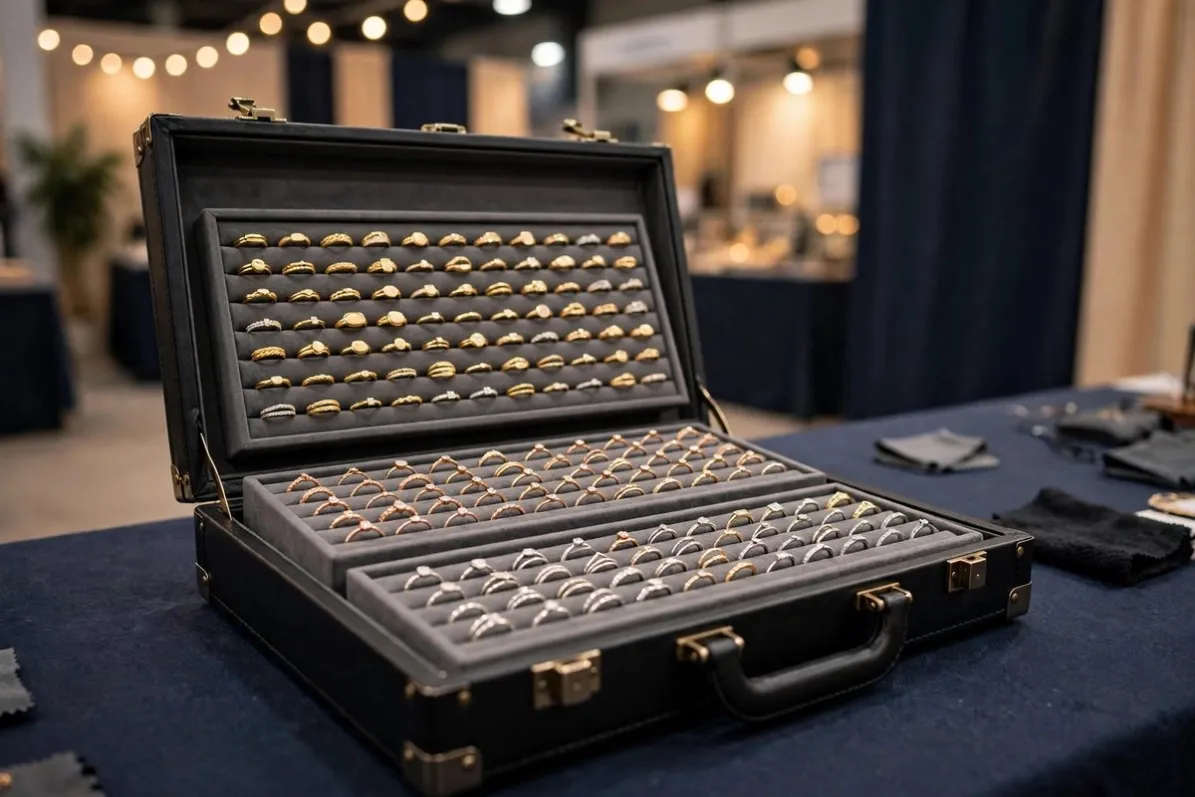
The showroom best practice and the road best practice are the same: show the design, protect the original.
7. How a Dummy Program Fits into a Security Routine
A dummy program is adopted in five practical steps:
- Split the inventory roles. Decide which pieces exist as real stock, which as display dummies, and which as both — the standard model is: the design lives in the case as a dummy, the real piece lives in the safe.
- Build the dummy set to selling standard. Specify brass, stone-set, tone-matched dummies against an approved sample, exactly as for any display program (see the spec guide).
- Reset the overnight routine. Cases and windows stay dressed with dummies; all real stock goes to the rated safe, every night, without exception trays.
- Tell your broker what changed. Describe the new display layer and the reduced exposed value, and confirm how the policy records it.
- Extend the same sets to the road. Build travelling and trade-show kits from the same program, so no real collection needs to travel as display stock.
Frequently Asked Questions
Do display dummies prevent jewellery store break-ins?
No. Display dummies do not prevent break-ins and are not a deterrent system. What they change is the outcome: a thief who breaks into a case of dummies takes replaceable replicas instead of insured inventory, so the loss is glass and fixtures rather than stock, claims and downtime.
Should real jewellery be kept in a safe overnight?
Yes — that is the standard industry guidance repeated by security experts after major store burglaries: real inventory belongs in a rated anti-burglary safe overnight, not under glass. A display dummy program is what allows a store to follow that guidance without emptying and re-dressing its cases and windows every day.
Will display dummies lower my jewellery insurance premium?
Not necessarily, and no one can guarantee it. Policies differ, and premiums depend on the store's full risk profile. What a dummy program does change is the structure of the risk: less insured value is exposed on display, less often. Bring that change to your own insurer or broker and ask how your policy treats display stock versus safe-kept stock.
Why not just empty the display cases every night?
Many stores do, and it works when it never fails. The costs are nightly labour, total dependence on routine and discipline, safe capacity as the collection grows, and the window display that is impractical to strip and re-dress daily. Displaying dummies removes the routine rather than policing it: the case stays dressed and the safe holds the value.
Do thieves know the rings in the case are dummies?
The security logic does not depend on secrecy. Whether or not a thief knows, the value physically present in the case is the replicas' replacement cost, not the collection's value. The program limits the loss from an incident; it is not a bluff.
Are display dummies useful for trade shows and travelling sales kits?
Yes. Travelling kits built on dummies show the complete collection while carrying a small fraction of its value, reduce transit-insurance exposure on display stock, travel through customs as low-value samples, and can be restocked quickly from the standing program if a piece is lost or damaged.
Do display dummies replace safes, alarms or insurance?
No. Dummies complement the standard layers of jewellery store security — rated safes, alarms, case and window protection, staff procedures and insurance. Real pieces still need all of them. A dummy program reduces what is exposed to be taken; it does not protect what remains.
About FKS Jewelry
FKS Jewelry is a custom ring manufacturer in Dongguan, China, making rings to the designs of jewellery brands, wedding-ring companies, wholesalers and product developers. FKS manufactures brass display ring dummies for gold and platinum jewellery brands — stone-set, micro-engraved, and finished in gold-tone, rose gold-tone and white gold-tone plating to match a real collection — alongside finished OEM rings in stainless steel, titanium, black titanium, tantalum, black zirconium, cobalt, Damascus steel and carbon fibre. Showroom, photography, trade-show and travelling-sales programs are built from a CAD file, a technical drawing, a product photo or a physical sample, with sample approval before batch production and work carried out under NDA.
Discuss a display program that covers your showroom, your windows and your road kits with our engineering team.
Related reading: