Why Brands Photograph Plated Brass Dummies Instead of Real Gold
A camera records a ring's surface, not its core metal — so brands shoot gold-tone plated brass dummies and keep real gold in the vault.
Why Brands Photograph Plated Brass Dummies Instead of Real Gold
Quick answer: Brands photograph plated brass dummies instead of real gold because a camera records a ring's surface — its plating, tone and finish — not the metal underneath. A gold-tone plated brass dummy with a matched finish renders the same warm metal, the same highlights and the same reflections as the real piece, while the logistics change completely: no insured inventory travels to a studio, sets can be shot in parallel in several places, and any piece can be reshot months later from the same standing set. The catch is fidelity: the dummy must match the original's tone, finish, stone layout and surface quality at macro scale.
Photographing gold jewellery is notoriously difficult — reflective metal acts like a mirror, showing the camera, the studio, and every light stand in the frame. That is why many brands photograph high-fidelity brass display dummies instead: the plating renders the same warm metal on camera, without shipping insured inventory to a studio. This guide explains the practice, corrects one common misunderstanding about it, and sets out what it takes to make it invisible.
In this guide:
- Why is gold jewellery so hard to photograph?
- Does a brass dummy photograph differently from real gold?
- What changes when you shoot brass dummies?
- What about e-commerce and marketplace image standards?
- What fidelity does a photography dummy need?
- The honest limits: what a photography dummy should not be used to claim
- How to run a product shoot on a dummy set
- Frequently asked questions
1. Why Is Gold Jewellery So Hard to Photograph?
Polished metal is a mirror, and a ring is a mirror bent into a circle: it reflects the whole studio — camera, lens, lights, and every unlit gap in between. "Jewellery has to be one of the hardest things to photograph well" is a sentiment repeated across photographer communities on Reddit, and the core problems are always the same three:
- Mirror reflections — polished rings reflect the camera, the lens, and the room, including the photographer.
- Dark reflections — wherever the studio is unlit, the metal shows a dark patch. On a curved band, some part of the ring is always facing an unlit direction.
- Retouching load — almost every professional jewellery shot is retouched afterwards to clean reflections, even out highlights and remove set dust and fingerprints.
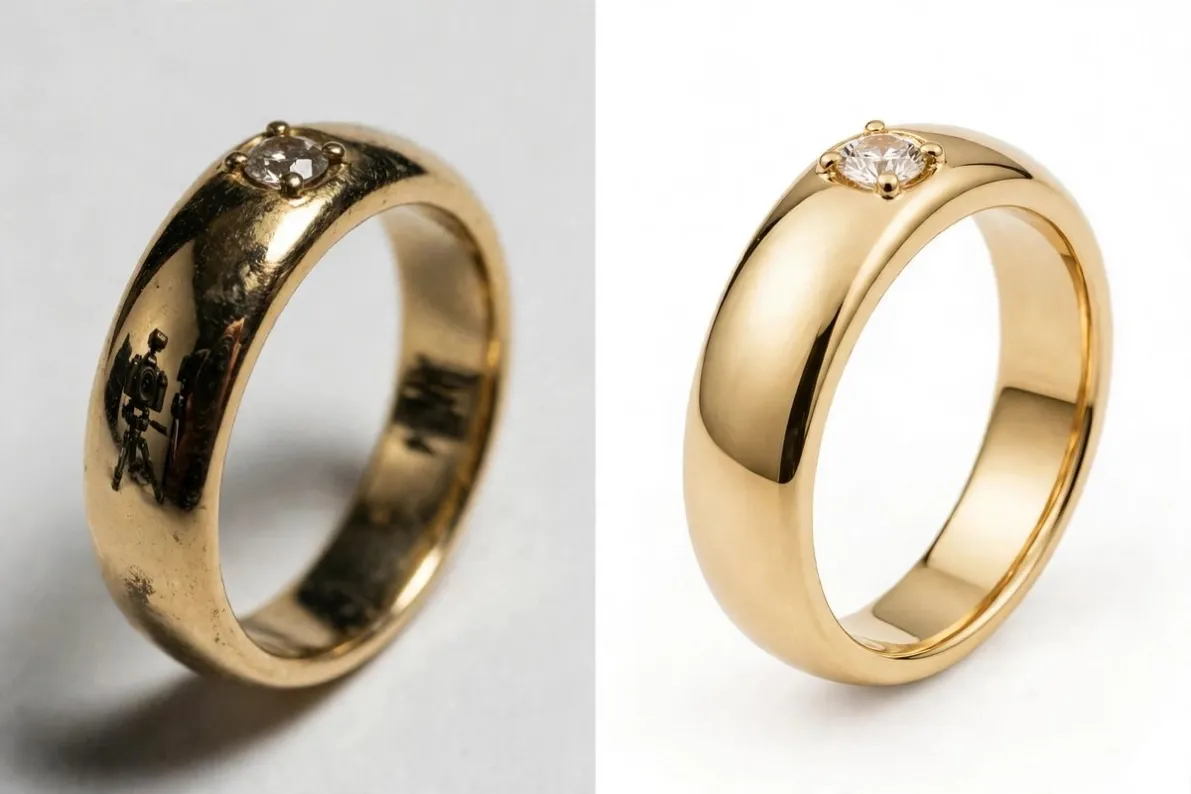
None of these problems is caused by the metal being gold. They are properties of a polished reflective surface — which is precisely why the solution can be a different metal wearing the same surface. What real gold changes is the cost of the exercise: the piece being shot is high-value inventory, in someone else's studio, on someone else's schedule.
2. Does a Brass Dummy Photograph Differently from Real Gold?
No — and it is important to be precise about why. A photograph captures the light reflected from the outermost surface of the object. On a plated dummy, that surface is the gold-tone plating and its finish, which is also what the eye — and the sensor — sees on the real piece at the surface level.
This cuts both ways, and honest expectations matter:
- The dummy does not make photography easier. A plated brass ring is exactly as reflective, shows exactly the same dark patches, and needs exactly the same lighting skill and retouching as a real gold ring. Anyone who expects dummies to solve the reflection problem will be disappointed; lighting solves the reflection problem.
- What the dummy changes is everything around the photograph. Risk, insurance, availability, parallelism and repeatability — the subject of the next section. Brands that adopt photography dummies are buying logistics, not optics.
3. What Changes When You Shoot Brass Dummies?
A gold-tone plated brass dummy with a matched finish reflects light the way the real piece does — same warmth, same polish, same highlight curve. On camera, the difference is invisible. What changes is everything around the shoot:
| Shooting real gold | Shooting plated dummies | |
|---|---|---|
| Insurance & security | Insured inventory travels to and stays at the studio | Low-value replicas ship anywhere |
| Risk | Loss, theft or damage on set affects real stock | A lost or damaged piece is replaced from the program |
| Availability | The piece must be in stock, unsold and un-resized | The dummy set always exists, even for sold-out designs |
| Parallel shoots | One real set can only be in one place | Duplicate sets shoot in several studios and markets at once |
| Reshoots | Months later, the original piece may be sold or altered | The same set reshoots the same design, identically |
| Retouching | Same | Same |
| Result | Catalogue images | The same catalogue images |
Three of these rows deserve emphasis because they are the ones brands feel most:
- Availability is the quiet revolution. A real collection is a moving target: best-sellers sell out, pieces are resized, stock rotates between stores. A catalogue that must be shot from real stock is hostage to that movement. A dummy set is a fixed asset — every design, in every tone, permanently shootable.
- Parallelism collapses timelines. E-commerce in one country, a lookbook in another, a dealer's local content in a third: with duplicate dummy sets, all three shoot in the same week instead of queuing for one insured parcel.
- On-model and location work gets simpler. Lifestyle shoots put rings on hands, in cafés, at weddings, on beaches. With dummies, a lost ring is an inconvenience; the creative team can work without a security shadow, and real pieces are never worn down by a day of handling on set.
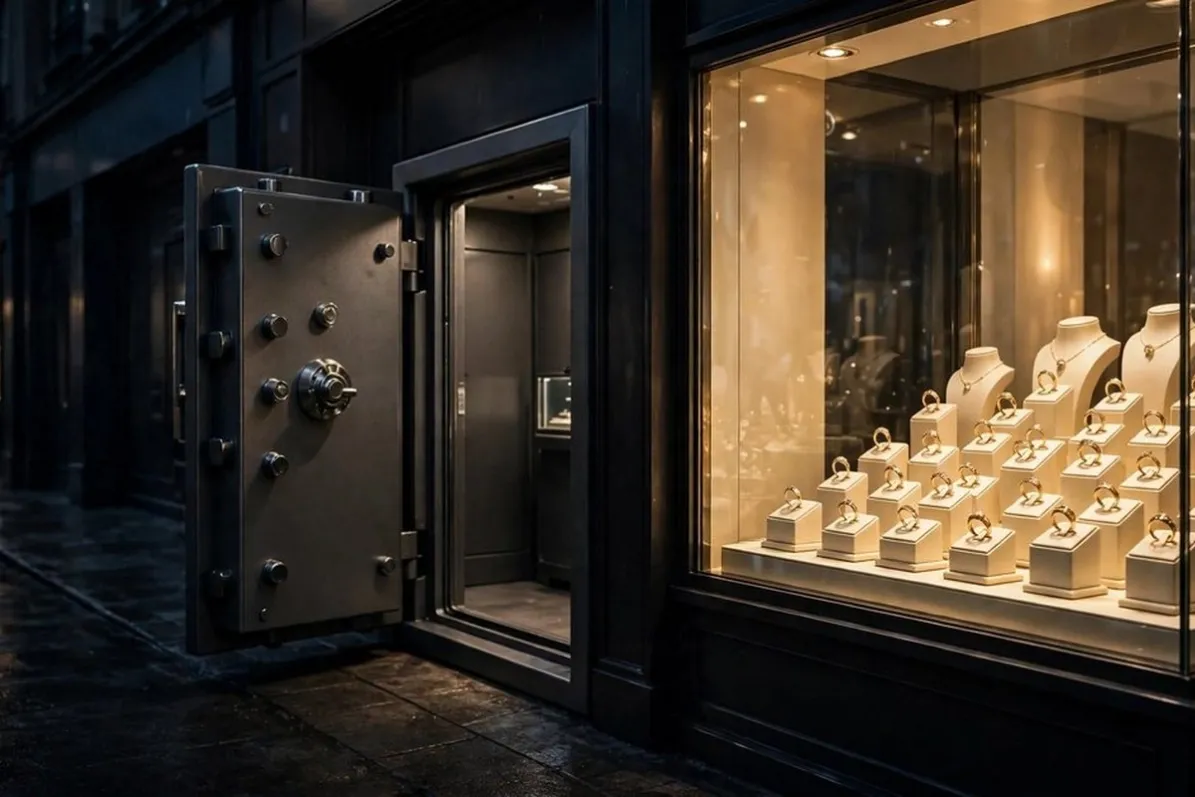
E-commerce catalogs, marketplace listings, lookbooks and ads can all be shot from dummies while the real collection never leaves the vault — the same risk logic as the showroom case, set out in How Display Dummies Cut Theft, Insurance and Overnight Risk.
4. What About E-Commerce and Marketplace Image Standards?
Marketplace photography — white-background main images, consistent angle sets across a catalogue — rewards consistency more than drama. A full dummy set is a consistency machine.
- One rig, whole collection. Every SKU can be shot in the same session, on the same rig, at the same angle, lighting and scale — instead of across weeks as real stock becomes available, with subtly different setups creeping in.
- A standard angle set per design. Front, three-quarter, side profile, on-hand: a dummy set lets the photographer work through the same shot list for every design, which is the visual uniformity that makes a catalogue page — and a marketplace grid — read as one brand.
- Uniform colour across the grid. When every image on a page shows the same gold tone, shoppers trust the page. Tone drift between images shot months apart from different real pieces is a common, quiet cause of "the colour looked different" returns; a single approved dummy set fixes the tone reference once.
5. What Fidelity Does a Photography Dummy Need?
A photography dummy is judged at macro scale, where the camera is far less forgiving than the eye across a display case. It needs five things:
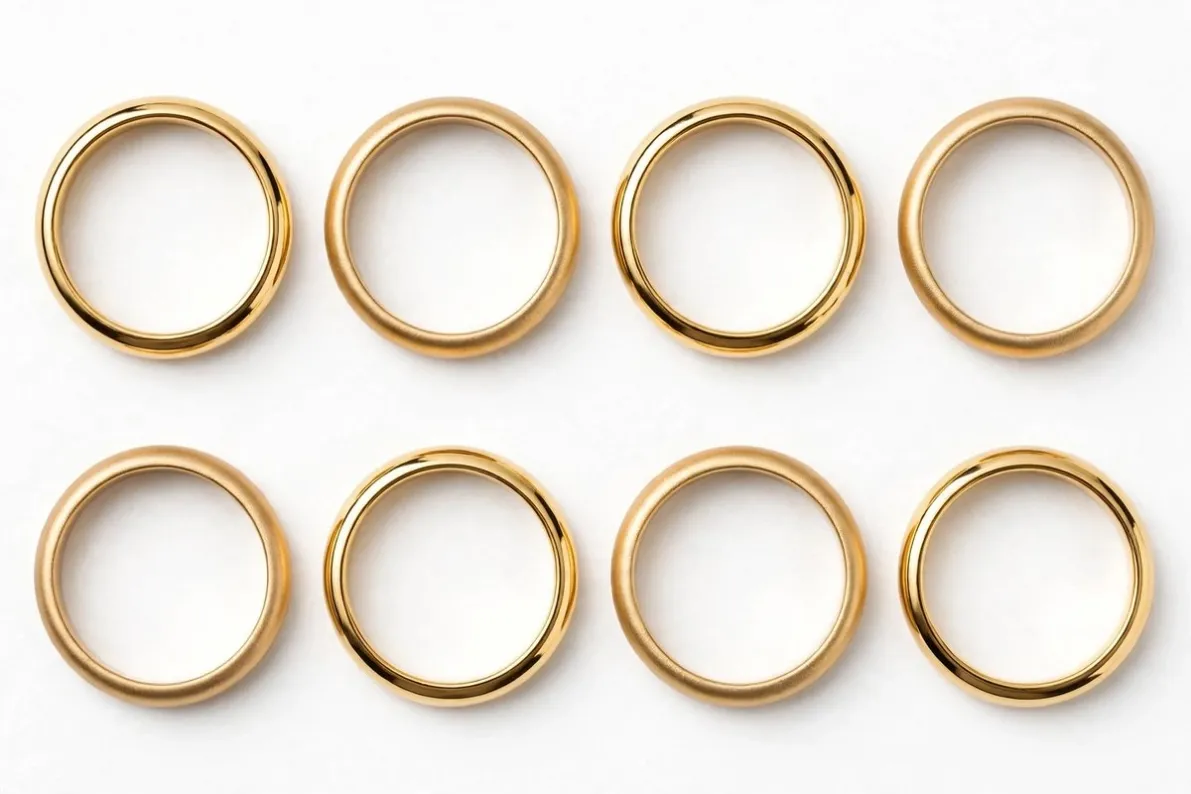
- Tone match — the plating must match the real collection's gold tone: gold-tone, rose gold-tone or white gold-tone, approved against the original. On camera, a half-step of tone difference reads clearly, especially across a grid of images.
- Finish match — polished dummies for polished pieces, satin for satin, brushed for brushed. Finish controls the highlight curve, which is most of what a metal photograph actually shows.
- Stone layout match — the setting style, stone sizes and layout must mirror the original. Macro lenses enlarge settings; simplified or glued stones that might pass in a case will not pass in a product photo (see When a Low-Fidelity Dummy Costs You the Sale).
- Clean, fine-jewellery surfaces — studio macro shots expose every flaw: casting texture, pitting, scratches, fingerprints. The dummy needs fine-jewellery surface quality and gloved handling on set; a photography-grade set is kept for shoots, not borrowed from the sales floor.
- Consistency across the set — tone and finish must hold across every piece in the set, because catalogue images sit side by side. This is a manufacturing control point: approve one sample against the original — under studio lighting, not only shop lighting — then hold the set to that sample, as set out in the display ring dummy spec guide.
A dummy that photographs cleanly at macro scale will also display cleanly in a showroom — the same fidelity standard serves both. The reverse is not always true, which is why photography is the stricter test.
6. The Honest Limits: What a Photography Dummy Should Not Be Used to Claim
A photography dummy represents the design — its form, tone, finish and setting layout. Used that way, it is an accurate image of the product the customer will receive. There are two uses it should not be put to:
- Documenting a specific real stone. A close-up presented as evidence of an individual diamond's or gemstone's actual clarity, colour or inclusions must be that stone, not a replica stone in a dummy. Design photography shows what the ring looks like; it does not certify an individual gem.
- Misrepresenting the product. The practice is legitimate precisely because the dummy is faithful: the delivered real ring matches the photograph. Images must always accurately represent the product sold, and brands remain responsible for the image rules of each marketplace or platform they sell on — fidelity is what keeps a dummy programme comfortably inside those rules.
These limits are not a weakness of the method. They are the same fidelity principle, applied to the brand's own claims.
7. How to Run a Product Shoot on a Dummy Set
A dummy-based product shoot runs in five steps:
- Approve the photography set against the originals. One dummy per design, checked for tone, finish and stone layout against the real piece, under studio lighting.
- Build the shot list by design. Every design, every tone, the same standard angle set — agreed before the shoot day, not improvised on it.
- Ship sets where they are needed. Duplicate sets go to each studio or market in parallel; no insured inventory travels.
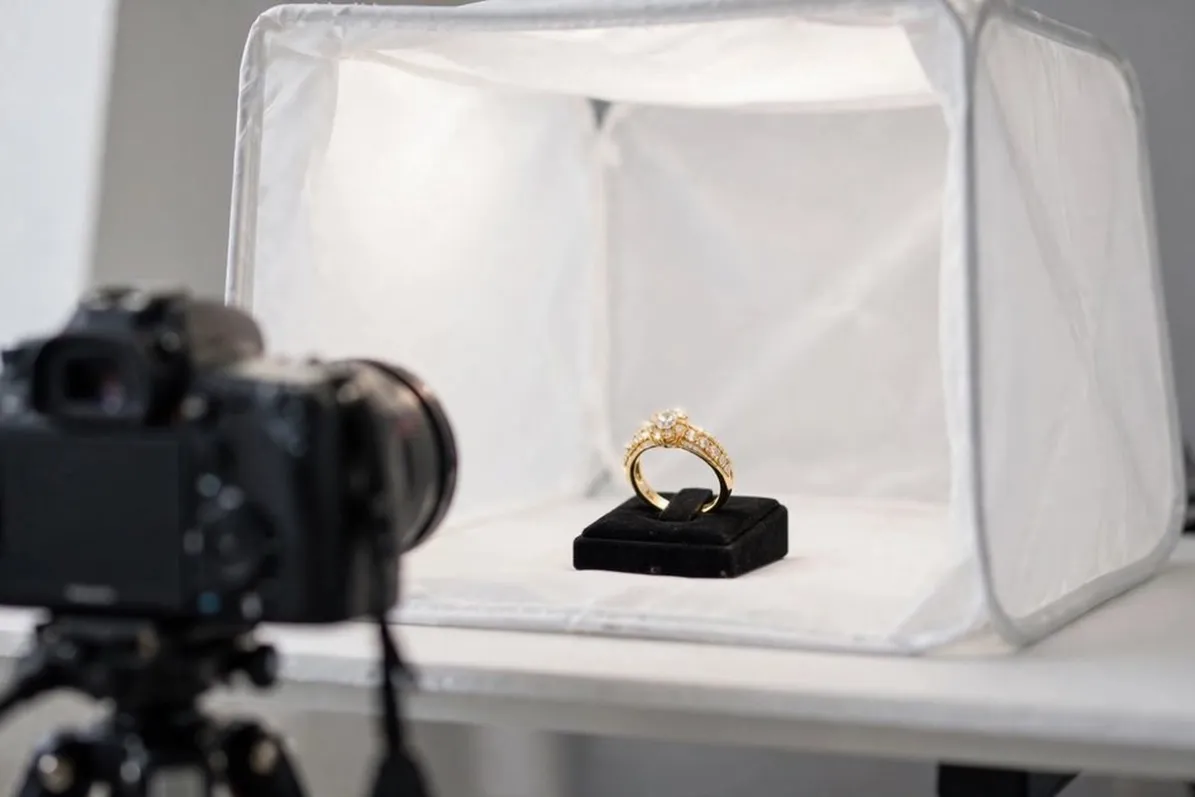
- Shoot and handle to studio discipline. Gloves and soft cloths between shots, one rig and one lighting setup per series, retouching as normal — the workflow is identical to shooting real pieces, minus the security overhead.
- Archive the sets. The photography sets are stored as standing assets, so reshoots, new angles and new formats (video, 360°, social cuts) can be produced months later to the same standard.
Frequently Asked Questions
Can you tell from a photograph whether a ring is real gold or a brass dummy?
No, not when the dummy is made to photography standard. A camera records the surface — plating, tone, finish and setting — and a gold-tone plated brass dummy that matches the original on all four renders the same image as the real piece. The core metal is not something a photograph can show.
Is brass easier to photograph than real gold?
No. A plated brass dummy is just as reflective as real gold, shows the same dark reflections from unlit areas of the studio, and needs the same lighting technique and retouching. Brands use dummies for logistics — no insured stock travelling, permanent availability, parallel and repeatable shoots — not because the photography itself gets easier.
Why do brands photograph dummies instead of the real products?
Because the real collection is high-value, limited and constantly moving: pieces sell out, get resized and rotate between stores. Photographing real stock means shipping insured inventory to studios, shooting only what happens to be available, and being unable to reshoot a sold design. A dummy set is complete, permanent, duplicable and low-value, so shoots happen anywhere, in parallel, and again months later.
What fidelity does a photography dummy need?
A photography dummy needs tone matched to the collection (gold-tone, rose gold-tone or white gold-tone), finish matched design by design, the original's stone layout set properly, fine-jewellery surface quality that survives a macro lens, and consistency across the whole set. It should be approved against the original under studio lighting before the set is produced.
Can dummy photographs be used for e-commerce and marketplace listings?
Yes — catalogues, marketplace listings, lookbooks and ads are routinely shot from high-fidelity dummies. The condition is accuracy: the photograph must represent the product the customer receives, which a faithful dummy does for design, tone and finish. Brands should still follow each platform's image policies, and should not use a dummy close-up to document an individual real gemstone's characteristics.
What about on-model and lifestyle photography?
Dummies are especially practical on-model and on location: rings are worn, handled and taken outdoors all day, and a lost or damaged dummy is simply replaced from the program. The real pieces avoid set wear, resizing marks and the security arrangements that high-value stock on location would require.
How do reshoots stay consistent with the original catalogue?
Because the photography dummy set is archived as a standing asset. Six months or a year later, the same design in the same tone and finish can be shot again — new angles, video, 360° spins or social formats — and the new images sit seamlessly beside the originals, which is rarely possible once the real piece has been sold or altered.
About FKS Jewelry
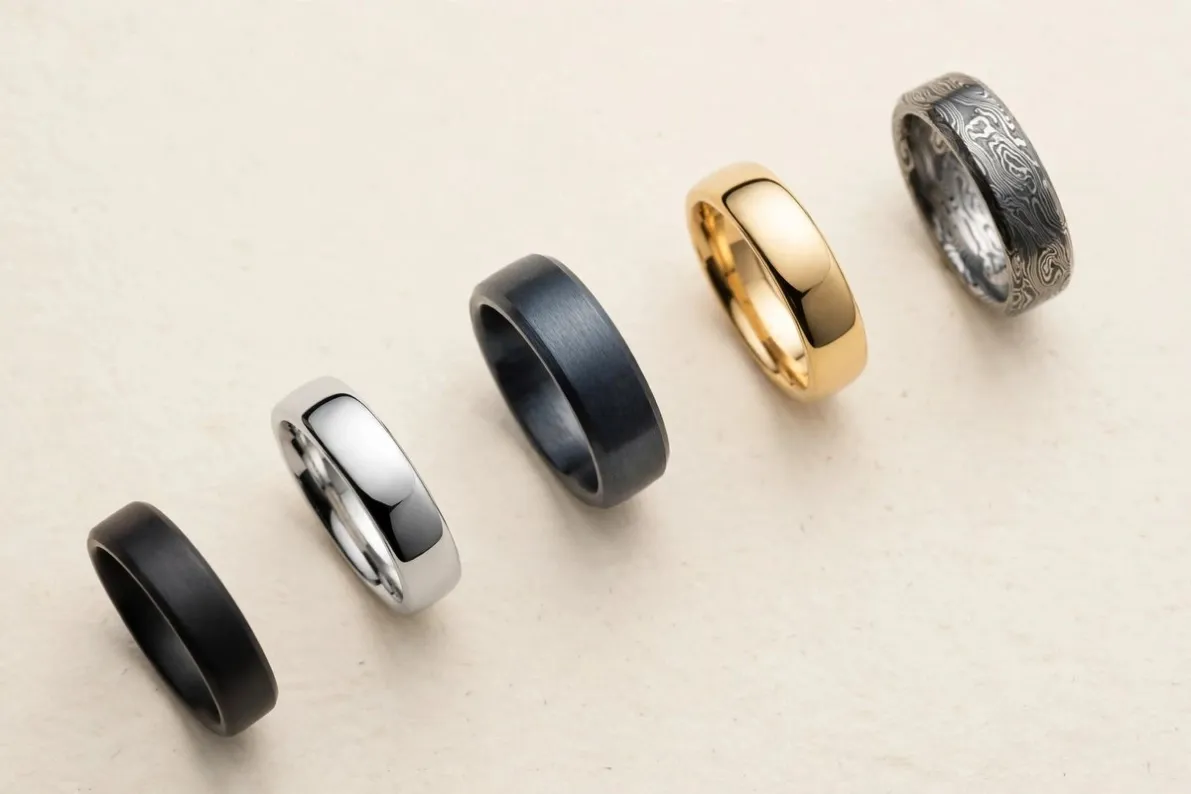
FKS Jewelry is a custom ring manufacturer in Dongguan, China, making rings to the designs of jewellery brands, wedding-ring companies, wholesalers and product developers. FKS manufactures brass display ring dummies for gold and platinum jewellery brands — stone-set, micro-engraved, and finished in gold-tone, rose gold-tone and white gold-tone plating to match a real collection — alongside finished OEM rings in stainless steel, titanium, black titanium, tantalum, black zirconium, cobalt, Damascus steel and carbon fibre. Photography-grade surface finish is part of the same approved-sample process: programs are built from a CAD file, a technical drawing, a product photo or a physical sample, with sample approval before batch production and work carried out under NDA.
Discuss a display and photography program — one set standard for your case, your catalogue and your campaigns — with our engineering team.
Related reading: